Why a Good Story Works in One Room and Falls Flat in Another
A story that engages one audience may leave another silent. Learn how to adapt your opening, examples and questions without losing your message.
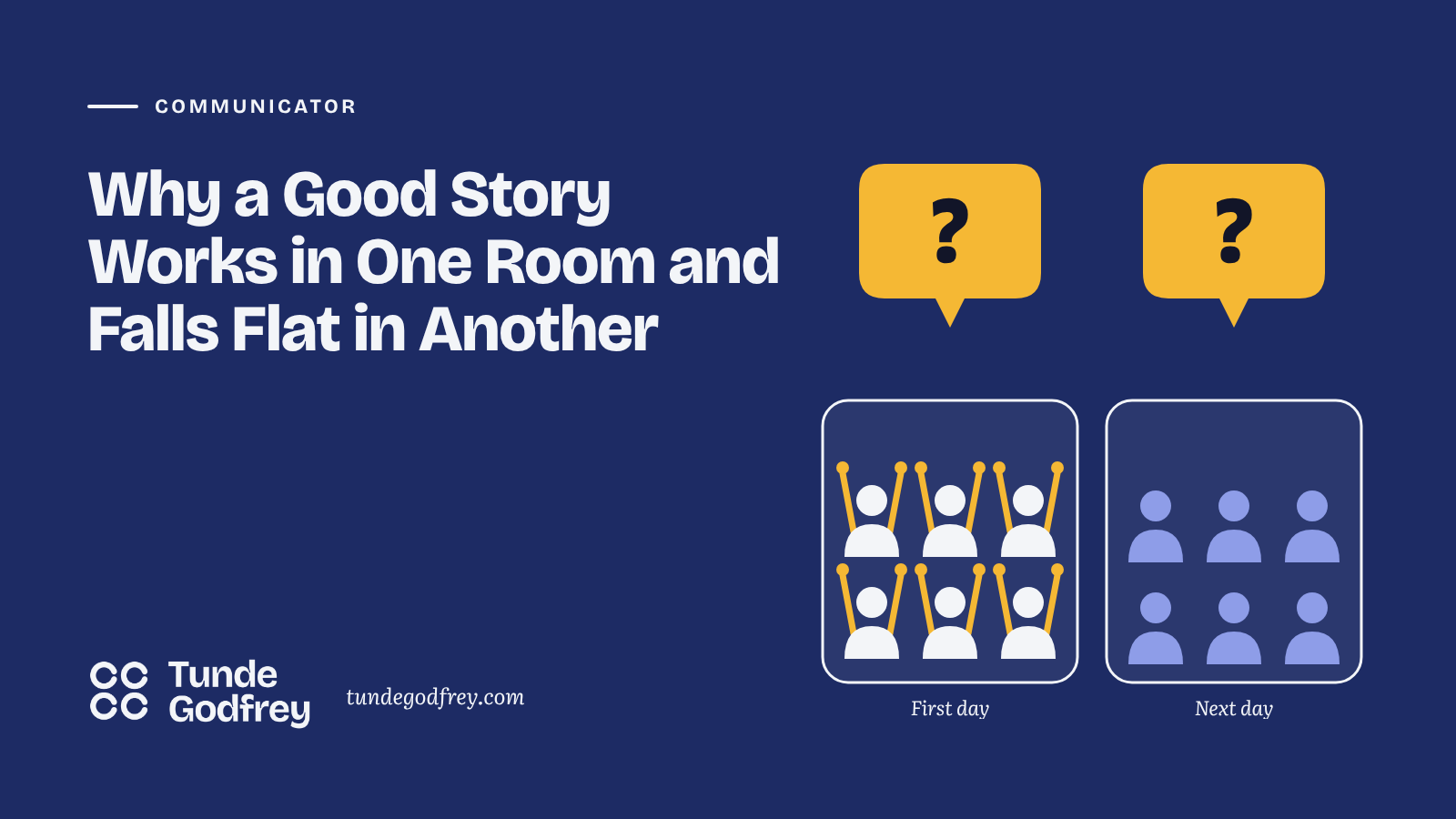
Two restaurants stand side by side. One has a queue stretching out of the door. The other is empty.
Which one would you enter, and why?
I once used that question to open a session. Before I had finished asking it, hands were already going up. People began discussing their choices and gently disagreeing with one another over restaurants that did not exist.
It gave me exactly the opening I wanted. The participants were thinking, speaking and listening. When I connected the discussion to trust and the choices people make about brands, I had their attention.
The following day, I used the same opening with another group.
Same restaurants. Same question. Same delivery.
This time, there were a few polite nods. No hands. The room sat there.
It is an uncomfortable moment when yesterday's successful opening becomes today's silence. You start wondering whether you have lost your energy, whether the participants are uninterested, or whether the story was never as good as you thought.
What I took from that experience was simpler: an opening that engages one room has to earn its place in the next.
The story is only part of the encounter
It is tempting to treat a good story as something that works wherever you take it. Find a strong hook, practise the delivery, then carry it from one audience to another.
But listeners bring their own experiences to the encounter. They decide what is familiar, what matters and whether the question is worth answering. A story acquires meaning in that meeting between the speaker and the audience.
In my case, the first group included people accustomed to solving practical and mechanical problems. The second was younger and largely occupied with administrative and support work.
My guess was that the first group heard a puzzle and wanted to solve it. Perhaps the second needed an example closer to its everyday experience. I cannot establish that from two sessions. It is an interpretation, not a finding about how people in those roles think.
Other explanations are possible. They might have been tired. They might have been less comfortable speaking in front of strangers. The timing or atmosphere could have mattered. Even my delivery may have changed in ways I did not notice.
That uncertainty matters. A quiet room gives you a reason to investigate, not permission to label its occupants.
Prepare for the people, as well as the topic
Knowing your subject does not tell you how to introduce it to everyone.
Suppose you are speaking about trust. A restaurant example might be useful for one group. Another might respond to buying a phone from an unfamiliar online seller. A third might connect with deciding who to ask for advice before choosing a course of study.
The central question remains similar: what gives you enough confidence to act?
The route into that question changes.
Before a session, I would suggest asking the organiser what participants already know, why they are attending and what decisions they face. Ask how familiar they are with one another and whether the group usually speaks freely. Those answers give you more useful preparation than an attendance sheet alone.
Then prepare more than one opening. You do not need three complete presentations. You need a few ways of bringing the same idea within reach.
Avoid assuming that age or occupation will tell you everything. A young audience can enjoy a demanding question. An experienced audience can appreciate a simple example. Use what you know as a starting point, then pay attention to the people who actually arrive.
Make participation easier
Sometimes the story is understandable, but the invitation to respond asks too much too soon.
An open question addressed to a room full of strangers can require someone to become the first public speaker. That is a bigger request than it appears from the front of the room.
You can lower that barrier. Ask participants to choose between two options by raising a hand. Give them a moment to think before inviting an answer. Let them discuss the question with the person beside them, then ask a few pairs to share.
These choices do not guarantee engagement. They give people different ways to enter the discussion, including those who have something useful to say but need a little time.
Also make clear that you are inviting reasoning, rather than testing for a hidden correct answer. The restaurant question becomes less interesting if participants suspect you are waiting to catch them out.
Respond to the room you have
When an opening falls flat, repeating the question more loudly rarely resolves the uncertainty behind the silence.
You can pause and offer a different example. You can ask what people would need to know before making the choice. You can invite a private discussion before a public response. If time is short, explain the connection and continue without turning the silence into a confrontation.
Afterwards, record what happened while it is fresh. Note the question, the response, the circumstances and what changed when you adjusted your approach. Over several sessions, that record may reveal patterns worth testing.
A successful opening deserves to be kept. It also deserves to be reviewed.
Before you use your favourite story again, ask yourself: what do these listeners need in order to recognise themselves in it?